PRESS/

A bricklayer with a sense of humour Trisha Brown pioneered a new style of movement and dance

The first solo exhibition of her work in Britain explores her preoccupation with gravity, momentum, balance and repetition.

TWO PEOPLE stand side by side, the edges of their feet pressed together. Grasping each other’s wrists, they lean out to arm’s length, their backs straight; thus joined, they take a tentative step, and then another. If one partner falls, the other hauls them back up, keeping their feet in contact all the while. In Trisha Brown’s film, shot on Wooster Street in New York’s SoHo district in April 1970, the dancers evoke sailboats. Navigating the wide space of the street, their bodies are masts, their arms sails.

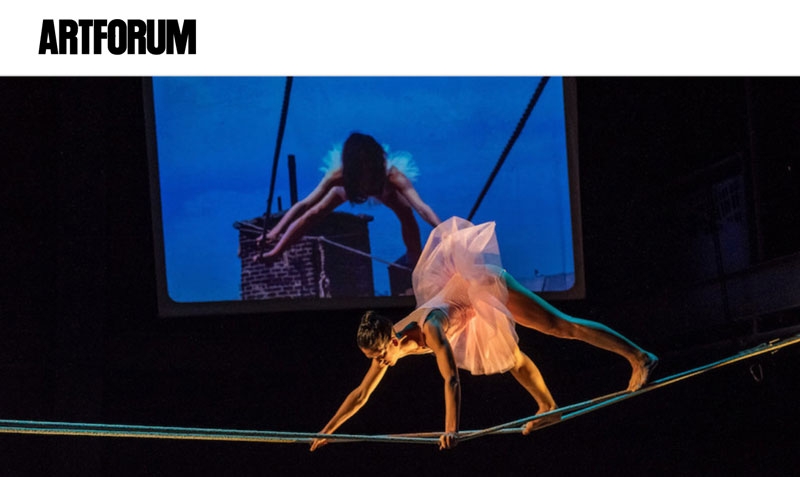
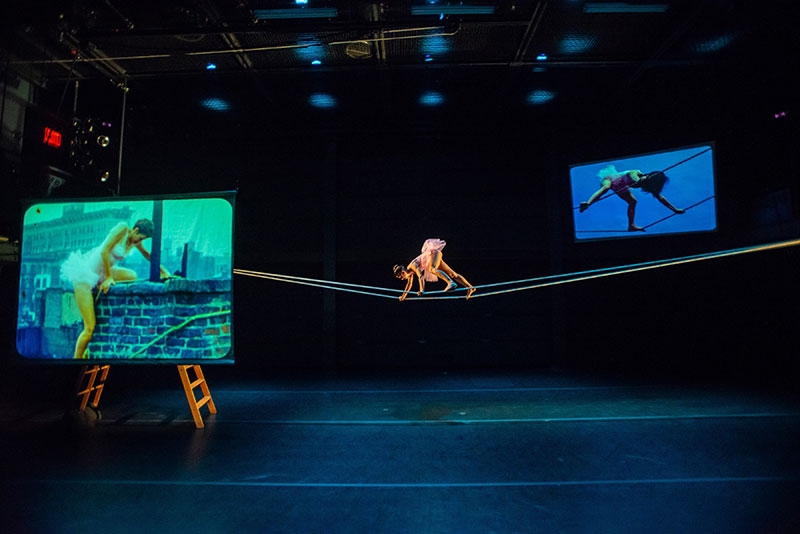
Cecily Campbell, "Ballet (1968)",  BAM, Brooklyn, 2018.  Photo: Stephanie Berger.

Trisha Brown at BAM Review in the Dance View Times

Carolyn Lucas and Diane Madden, who are the directors of the Trisha Brown Dance Company, seem to be making all the right decisions on how to proceed after the founder’s death eighteen months ago. Last year the company presented a splendid concert of late Brown works at Jacob’s Pillow, and at BAM Fisher this week the group showed earlier pieces with the same exactitude and sense of joy. 

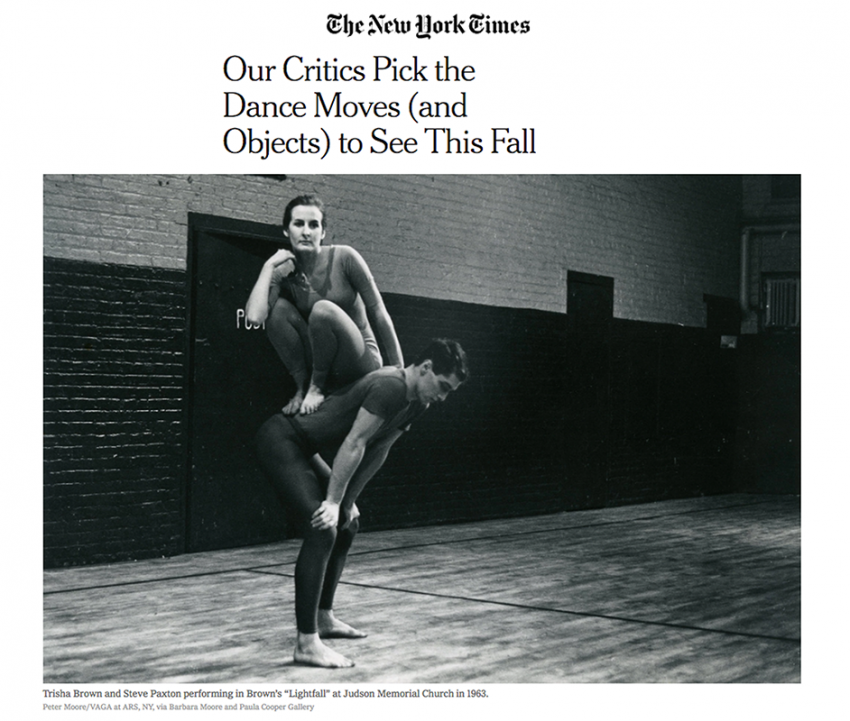
New York Times Critics Pick the Dance Moves (and Objects) to See This Fall

No! No! No! Every generation of modernist artists has applied a firm negative to points championed by the previous generation. In the 1960s, when large parts of the world were still taken aback by the dance negations implied or stated by Martha Graham (no to frivolity or merely surface psychology), George Balanchine (no to most décor or costume excess), and Merce Cunningham (no to conventional musicality), the young rebels around the Judson Memorial Church in New York went further.


Photo © Lois Greenfield

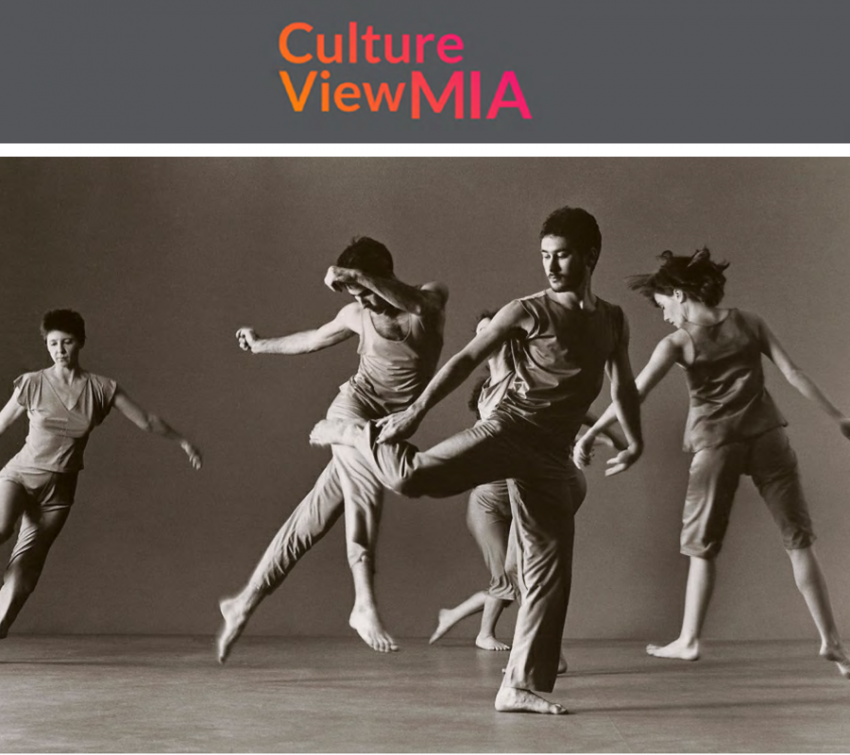
Voluptuous Rigor -  Trisha Brown Dance Company at ICA Miami

Luscious and austere. Severely abstract and exuberantly physical. In her half-century long career, choreographer Trisha Brown traversed the limits of expression to create a unique and profoundly influential body of work. Which makes it an extremely big deal that the Trisha Brown Dance Company is performing at the ICA Miami this week, their first time in Miami since 1990. (When the Miami Light Project presented them in the Robert Rauschenberg-designed Astral Convertible on the sands of Miami Beach.)

Photo © Andrea Mohin/The New York Times

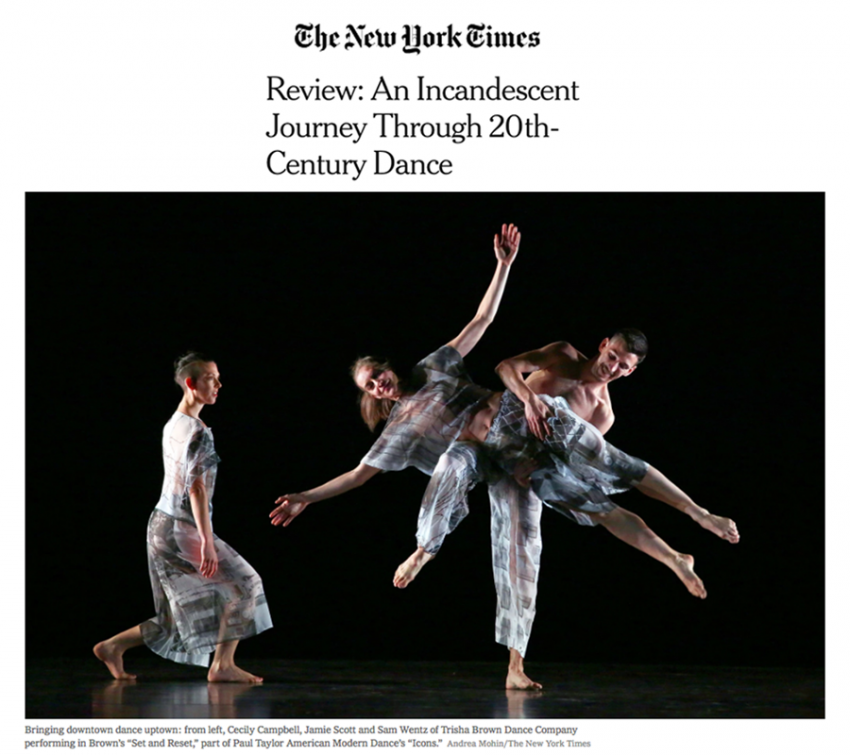
An Incandescent Journey Through 20th Century Dance

Isadora Duncan wrote in her autobiography: “I am an enemy to the ballet, which I consider a false and preposterous art, in fact, outside the pale of all art.”

What would she have made of Sara Mearns, a ballerina whose body seems to hold the air around her? On Sunday evening, Ms. Mearns, a principal at New York City Ballet, performed “Dances of Isadora,” staged and directed by Lori Belilove as part of the Paul Taylor American Modern Dance program “Icons.”

Now in its second season, “Icons,” presented with American Dance Festival, celebrated three of the world’s most important choreographers: Duncan; Trisha Brown, with “Set and Reset” (1983); and Paul Taylor, represented by “Esplanade” (1975). It was an incandescent journey through 20th-century dance.

Photo © Julieta Cervantes

A tribute to the American choreographer Trisha Brown at the Théâtre de Nîmes

Trois pièces de Trisha Brown seront reprises par les danseurs de sa compagnie en hommage à la chorégraphe disparue en 2017.

Les hommages se succèdent entre Europe et New York, et tout spécialement à la fin du mois, au Théâtre de Nîmes, pour célébrer le premier anniversaire de la disparition de Trisha Brown le 18 mars 2017, à l’âge de 80 ans.

Photo © Andrea Mohin

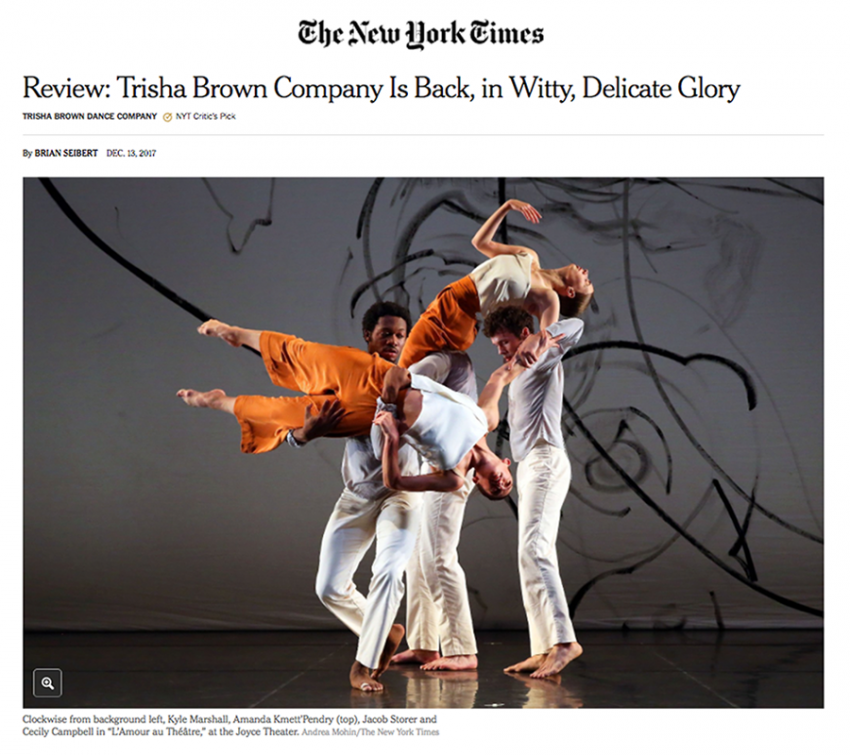
Review: Trisha Brown Company Is Back, in Witty, Delicate Glory

For a troupe that recently went on what was sometimes billed as a farewell tour, or at least as the end of something, the Trisha Brown Dance Company does not look as if it were going gently into any good night. The program that the group presented at the Joyce Theater on Tuesday is exactly the kind that it was supposed to be phasing out: a repertory sampler in a proscenium theater. Would that all broken promises were so wonderful.

Video: Gia Kourlas

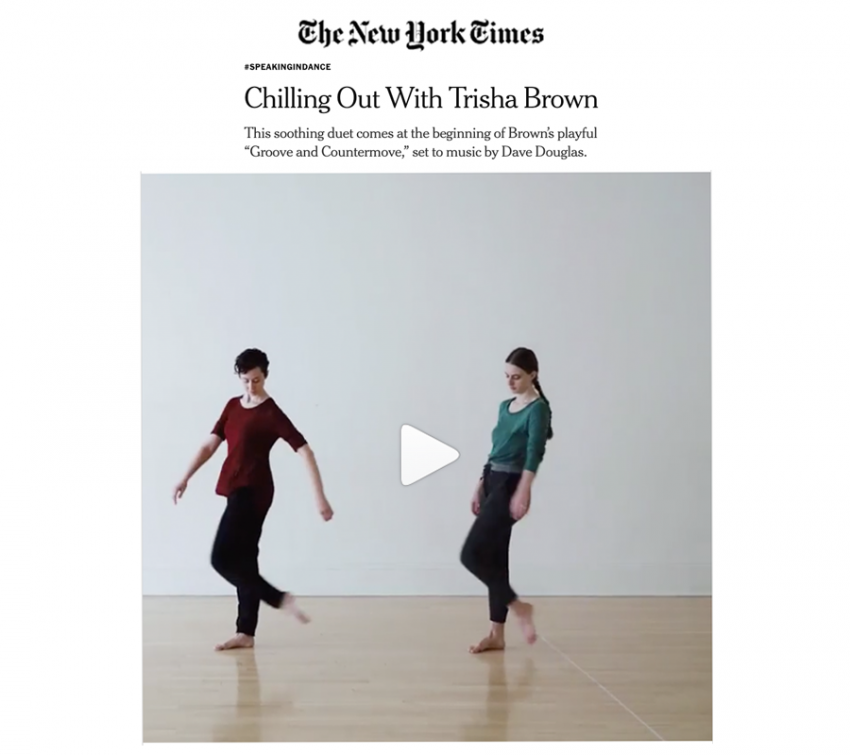
Chilling Out with Trisha Brown

#SpeakingInDance | “Some days there’s more sultriness or more sexiness and on other days there’s a void of that,” @akmettz said of dancing #TrishaBrown’s playful “Groove and Countermove.” “It just keeps shifting, depending on where we are and who I’m doing it with.” Part of @trishabrowncompany’s season at @thejoycetheater beginning next week, "Groove" is set to music by the jazz composer @davedouglas and begins with this soothing stunner of a duet in which Amanda (with the braid) glides seamlessly alongside Leah Morrison. 

Photo © Nathan Bajar for The New York Times

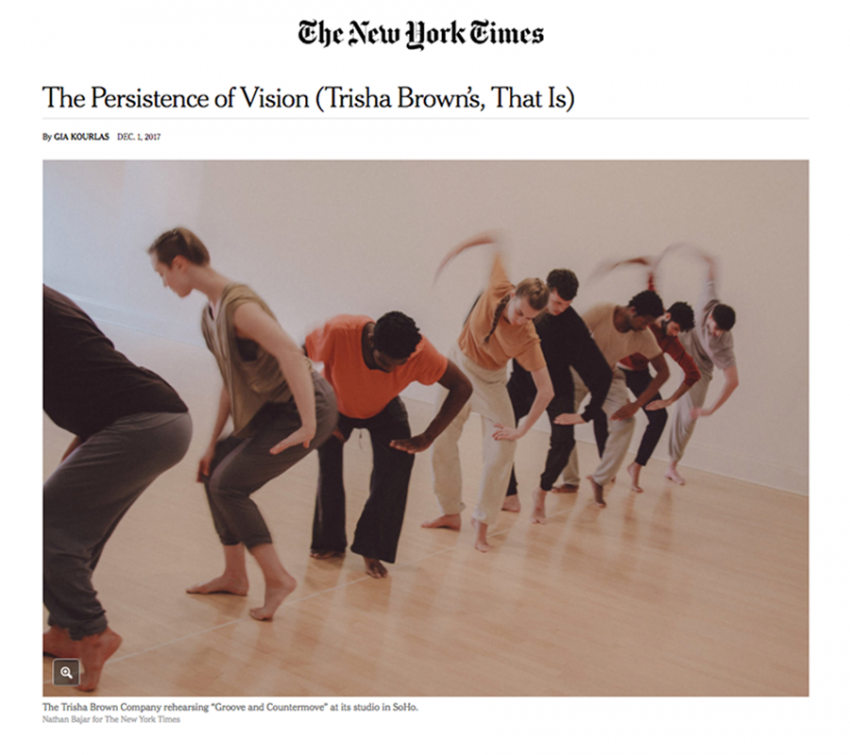
The Persistence of Vision (Trisha Brown’s, That Is)

Less than a year ago, the Trisha Brown Dance Company performed what were to be its final programs of works for the traditional proscenium stage. But that plan didn’t turn out as expected.

The idea was that the company would leave the proscenium stage behind to focus on a new performance model, a series called “Trisha Brown: In Plain Site,” in which the choreographer’s signature works would be reframed by showing them in unconventional sites, often outdoors or in museums.

It was an imaginative way, especially in the financially strained dance world, to keep Ms. Brown’s work alive and in the public eye. And it worked — so well, in fact, that presenters wanted more.

Your support keeps TBDC moving, make a fully tax-deductible gift today.

Join TBDC newsletter to stay informed about the latest happenings.